
Tylent Insight
Welcome to the Lyvra Community Tech Blog

Gravimetric Control: Why the De-Facto Standard Is Reaching Its Limits
Gravimetric verification transformed automated i.v. compounding by improving traceability and reducing operator error compared to manual volumetric dosing. Yet from an engineering perspective it also imposes structural limits. In most systems, weighing occurs only before and after dosing, in mechanically noisy environments, making real-time monitoring impossible and turning verification into a retrospective pass/fail check. The next step for automation is not to abandon gravimetry, but to complement it with sensing and control technologies that measure and correct dosing in real time.

Infusion Sets and Spiking: The Unautomated Step That Undermines Safety
Automation has transformed many aspects of IV compounding, reducing operator contact with hazardous drugs during preparation. However, the attachment of infusion sets—spikes, pigtails, and administration lines—remains largely manual in current workflows. This final step reopens the system to contamination risks and occupational exposure, undermining part of the safety gains achieved earlier in the automated process. In practice, automation frequently stops just before the therapy is fully completed.
Why Throughput Numbers Mislead: Productivity Depends on the Workflow, Not Just the Robot
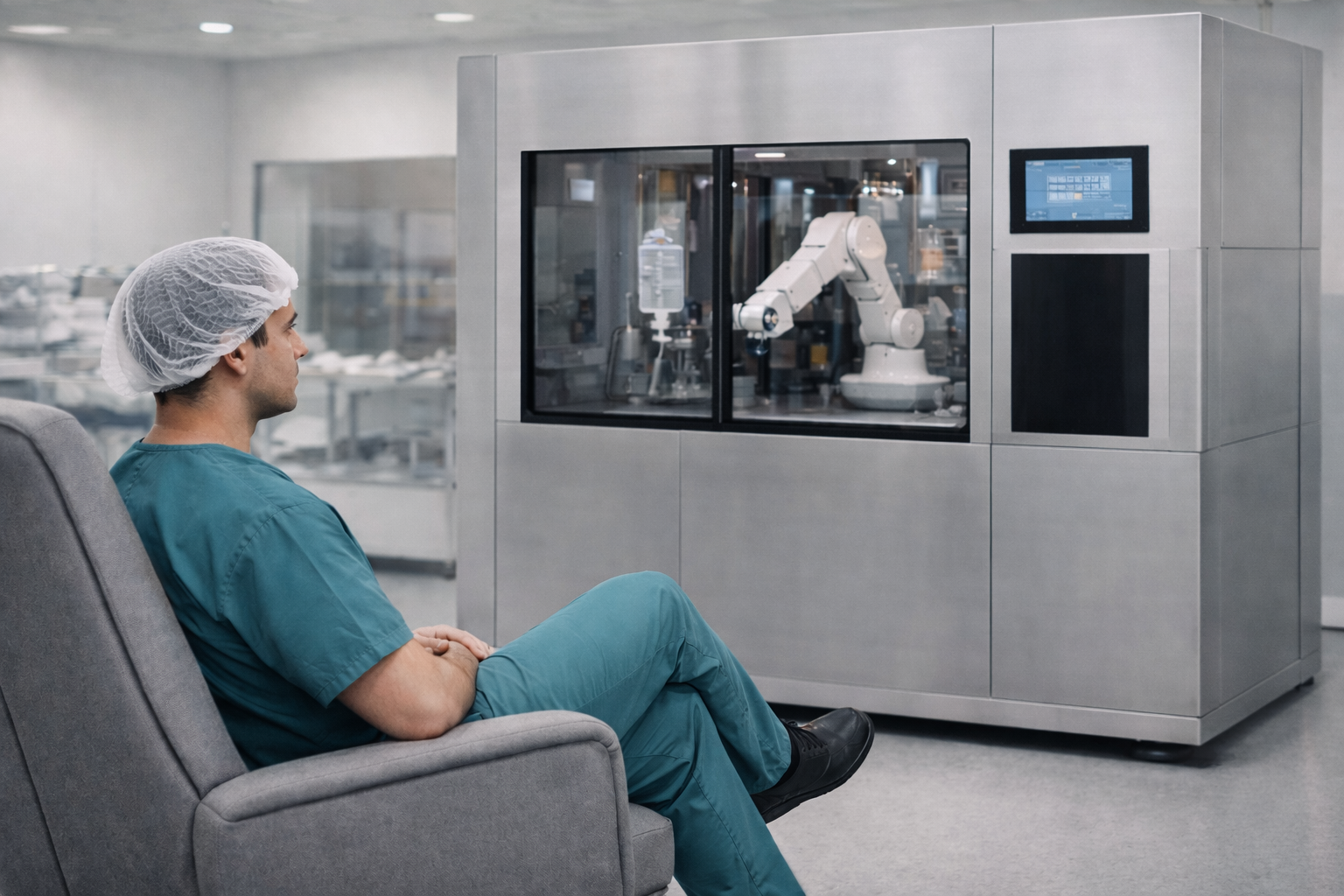
Throughput figures—doses per hour, preparations per shift—are widely used to evaluate i.v. compounding robots. But the scientific literature shows that productivity is not a property of the robot itself. It emerges from the entire workflow: preparation, logistics, supervision, and post-processing. When these factors are ignored, throughput numbers can be deeply misleading.

The Hidden Bottleneck: When a Robotic Arm Becomes the System Limiter
In many IV compounding systems, the real bottleneck isn’t software or sensing, but architecture. When a single robotic arm performs every step, the entire workflow becomes serial, turning that actuator into a mechanical choke point. The result: as variability increases, cycle times grow and productivity drops. The future of automation is not simply a better robot, but architectures built on parallelism, orchestration, and scalable workflows.

Are There Really “Generations” of I.V. Compounding Automation?
i.v. compounding automation is often described in “generations,” suggesting major technological leaps. In reality, most systems share the same core architecture: robots that replicate manual aseptic work inside an isolator while much of the surrounding workflow remains manual. The result is incremental improvement, not true transformation. When variability increases, throughput often approaches manual levels. A real next generation will require rethinking the workflow itself, designing automation around parallel processes and end-to-end control rather than simply imitating manual practice.